RideMETRO
- 3.5
- Rating
- 100.00K
- Installs
- Free
- Price
 Analysis by App-foxy
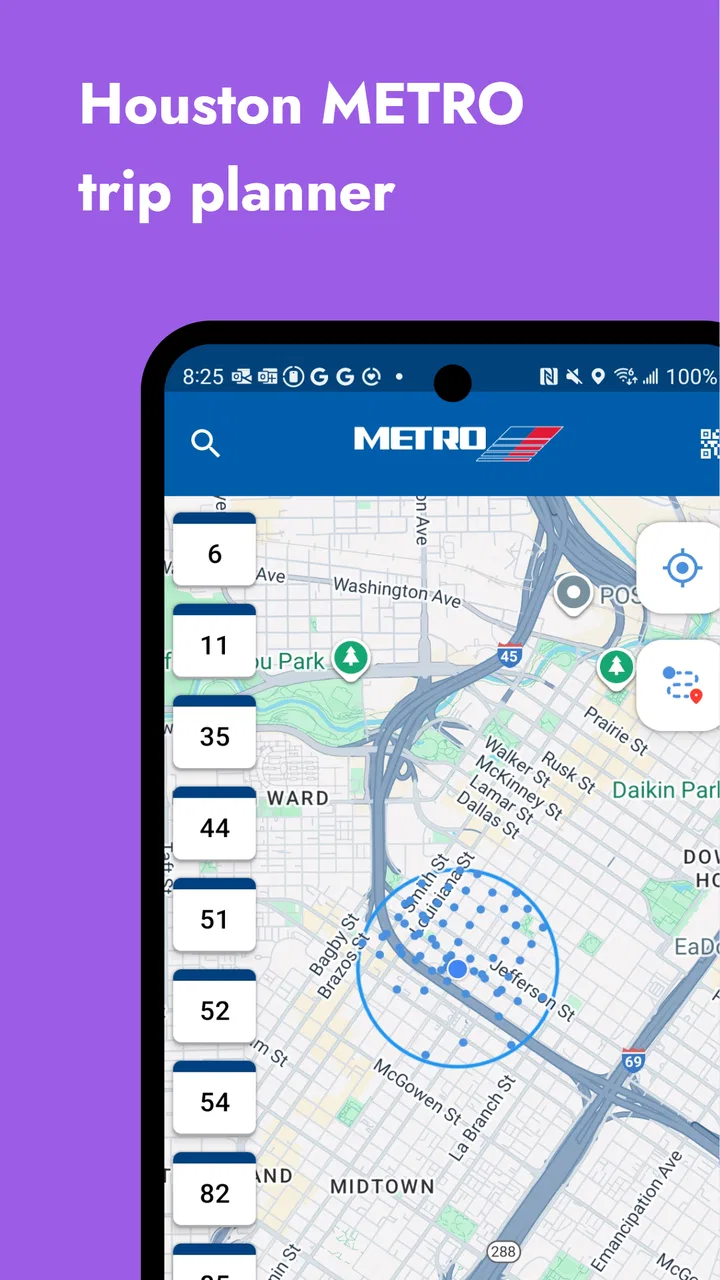
When I use public transport in Houston, the part that usually causes the most stress is not finding a route; it is turning that plan into an actual ride without juggling several separate tools. RideMETRO focuses on that connection. It is a free Maps & Navigation app from Houston METRO that brings trip planning and fare payment together for local buses and trains. That sounds simple, but in practice it changes the experience most when I am already on the move and need to make a decision quickly.
I see RideMETRO as a practical companion for people who regularly use Houston’s METRO network, rather than as a general-purpose travel app for every kind of journey. Its store summary is straightforward, and my impression is similar: the value is concentrated in one verified capability, planning a METRO trip and paying for it from the same app. It is available at no cost, is rated for Everyone, and has built a sizeable audience, with more than one hundred thousand installs and an average score of three and a half stars.
Planning a Houston trip and paying for it in one place
I find the strongest reason to try RideMETRO is that it treats choosing a Houston METRO route and preparing to pay as parts of the same trip, rather than separate errands. In the next section, I’ll look at how that connection feels in ordinary use—and why checking the journey before you leave can make a rushed transfer easier to manage.
You May Also Like

 Blood Strike: 2.5 Anniversary
Blood Strike’s Loadouts Turn Every Drop Into a Tactical Gamble
A close look at Blood Strike’s custom loadouts: how fast access to signature weapons reshapes its battle royale rhythm, rewards preparation, and narrows the gap between fights.

 Pandora - Music & Podcasts
Pandora’s Music Is Easy to Start, but Harder to Recover
Pandora’s strength is its low-effort path from a seed to a station. Its weak spot is how much confidence it asks you to place in connection, setup, and quiet recovery.

 8 Ball Pool
 Is Built on Rivalries, Rematches, and Routine
A close look at the rivalries, rematches, shared routines, and unanswered safety questions that turn a quick pool match into a persistent mobile community.

 Samsung Music
’s Quiet Strength Is Playing What You Already Own
Its reach comes less from spectacle than from dependable access to a personal library. That simplicity is both the app’s strongest retention engine and its ceiling.

 AccuWeather: Weather Radar
AccuWeather Review: A Quick, Clear Forecast for Everyday Decisions
For everyday plans, the best forecast is the one you can understand quickly. AccuWeather makes rain timing, radar, and local conditions easy to act on, with a few trade-offs.

 Hill Climb Racing
Why Hill Climb Racing Still Turns Crashes Into One More Run
A tiny car, a bumpy hill and one more upgrade: Hill Climb Racing keeps resurfacing because its simple chaos makes every near-miss feel personal.
More From Our News Desk



The useful idea behind the app
The strongest idea here is continuity. A route planner can tell me where to go, while a fare tool can help me board, but switching between unrelated apps adds small points of friction at exactly the wrong time. RideMETRO is designed around the Houston METRO service itself, so the journey and the fare are treated as parts of the same task.
That matters most for a rider who already knows the destination but is less certain about the practical details. I might be deciding whether a bus connection is manageable, checking a train option before leaving work, or trying to avoid arriving at a stop without a convenient way to pay. Instead of treating those as separate problems, the app gives me one place to begin.
I would not describe it as a replacement for every navigation tool on a phone. A broad mapping app may be better when I am comparing walking, driving, cycling, rideshare, and public transport together. RideMETRO makes more sense when the question is specifically, “How do I use Houston METRO for this trip, and how do I handle the fare?” That narrower focus is also its main strength.
What the experience feels like in practice
For an ordinary trip, I would start by entering the journey details in the app, reviewing the available METRO option, and then handling the fare as part of preparing to ride. The benefit is not just fewer taps. It is that the information I need is organized around the transit operator I am actually using, rather than being mixed with unrelated transport choices.
That workflow is especially useful before leaving home. I can check the proposed trip while I still have time to reconsider the departure, notice whether a connection looks inconvenient, and make sure the payment step is not something I will have to solve at the stop. I prefer doing that preparation in advance because public transport decisions become harder when I am standing outside, carrying a bag, or watching the time.
There is also a helpful distinction between planning a route and committing to it. I would use the app to explore the METRO journey first, then decide whether the timing and transfers suit me before paying. That habit reduces the chance of treating the first suggested route as automatically perfect. A route can be valid and still be awkward for a particular day, especially if I am traveling with luggage or need extra time at a transfer point.
A realistic everyday example
Imagine I am leaving an appointment in Houston and need to reach another part of the city without driving. I open RideMETRO before walking away from the building, enter the destination, and look at the METRO trip rather than trying to reconstruct the network from memory. If the journey involves a bus and a train, I can think about the whole sequence at once instead of finding one leg in a general map and then separately working out how to pay.
Before boarding, I would use the app’s fare function so that the payment decision is handled as part of the same preparation. If the suggested route requires a transfer, I would pay attention to the order of the journey and keep the phone ready for the relevant part of the ride. The practical lesson is to complete the planning while I have a stable connection and enough time, not after the vehicle has arrived.
That scenario also shows where the app earns its place. It is not necessarily giving me a revolutionary map; it is reducing the gap between “this is the route” and “I am ready to ride.” For a frequent METRO passenger, that can be more valuable than a long list of extra travel features.
Small habits that make the app more useful
My first tip is to plan the return journey before I start the outbound trip when I know my schedule is tight. The return may involve different timing or a different connection, and preparing it early avoids making the decision when I am tired or in a hurry. I would still recheck the trip close to departure, but having a basic plan already in mind makes the day less fragile.
My second tip is to separate route confidence from fare confidence. Seeing a route does not automatically mean I have completed the payment step. I would deliberately check both before leaving the app. This is a simple habit, but it prevents the common mistake of assuming that trip planning alone has prepared me to board.
My third tip is to use the app as a METRO-specific reference even when I begin with another map. A general map can help me understand the surrounding streets or compare transport modes, while RideMETRO can then handle the METRO-focused part of the decision. That combination is sensible for unfamiliar destinations: one tool provides the wider context, and this app keeps the transit and fare workflow together.
A fourth useful habit is to avoid waiting until the last possible moment to open it. Public transport planning is affected by walking time, transfers, and the need to complete payment. Even when the app is quick to use, a last-second workflow leaves no room to reconsider a route or deal with a phone that is low on battery. I get more value from it when I treat it as preparation, not as a panic button.
Where the focused design helps—and where it does not
The app’s Houston METRO focus gives it a clear advantage over a generic map when I already know that bus or train service is the answer. A general app may present several transport modes, walking alternatives, and driving results, which is useful for exploration but can also make the task feel scattered. RideMETRO keeps my attention on the local network and the fare step.
The trade-off is that I should not expect it to be my only travel tool for every situation. If I am deciding between a METRO trip and a rideshare, comparing several cities, or planning a journey that depends heavily on non-METRO services, a broader navigation app is likely more convenient. RideMETRO is best when the operator itself is central to the trip.
I also would not install it simply because I am visiting Houston for one short journey unless that journey specifically uses METRO and I want the fare workflow in the same place. A visitor who already relies on a familiar map may prefer to stay there for a quick comparison. On the other hand, someone making several bus or train trips can benefit from learning one focused tool instead of repeatedly improvising.
What to expect from the current app
RideMETRO has been available since April 10, 2012, and the current version is 2.68. That long presence suggests a product built around an established transport need rather than a temporary travel trend. I would still judge it by how comfortably it fits my current phone and routine, but its purpose is easy to understand: it serves Houston METRO riders who want trip planning and fare payment connected.
It requires a minimum operating system of version 10, so most people using a reasonably current device should check compatibility before relying on it for an important trip. The app is free, which makes trying it low-risk. The Everyone content rating also makes it suitable for a broad audience, including households where several people may need a straightforward transit tool.
The average rating of three and a half stars tells me to keep expectations realistic. I would not treat it as a universally polished navigation solution simply because it covers an important task. The mixed response is a reminder to test the planning and payment flow before a time-sensitive journey, especially if I am new to the app. A short trial run is more useful than discovering my preferred workflow at the station.
Who benefits most from using it
The clearest audience is the regular Houston METRO rider. If I use local buses or trains several times a week, combining route planning with fare preparation can remove repeated friction from my routine. The benefit compounds because I am not learning a new process for every trip; I am building familiarity with one METRO-centered workflow.
It is also a good fit for occasional riders who feel comfortable with smartphone navigation but are unsure about the fare side of public transport. The app gives that person a place to start without requiring a deep understanding of the network. I would recommend it to a friend visiting Houston who expects to make multiple METRO journeys and wants to prepare before boarding.
People who coordinate travel for another person may find the focused approach useful too. I can review a route and explain the basic sequence more clearly when the planning and payment questions are considered together. That is particularly helpful when the rider is unfamiliar with Houston, although I would still leave enough time for walking and transfers rather than relying only on the app’s route suggestion.
By contrast, I would steer a person toward a general navigation service if their main need is multimodal comparison. Someone choosing between driving, walking, cycling, rideshare, and public transport needs a wider lens than this app is intended to provide. I would also hesitate to make it the sole tool for a complicated day involving several operators or destinations outside the Houston METRO context.
My overall judgement
After looking at what RideMETRO is designed to do, I think its real value is practical rather than flashy. It connects two steps that riders often handle separately: working out a Houston METRO trip and preparing to pay the fare. That connection can make an ordinary commute, appointment visit, or unfamiliar bus-and-train journey easier to manage.
The app is not the right answer for every navigation question, and its middling average rating means I would test it before depending on it for an urgent trip. Still, for Houston residents, commuters, students, visitors, and anyone who repeatedly rides METRO, the focused design is convincing. If your journey begins and ends with Houston METRO, RideMETRO is worth trying before reaching for a broader map.
My recommendation is to install it, plan one low-pressure trip, and complete the fare workflow before you need it. That trial will quickly show whether its approach suits you. For me, the strongest reason to keep it available is not that it replaces every other travel app; it is that it gives Houston METRO travel its own clear, usable home. RideMETRO is developed by Houston METRO, remains free to use, and delivers the most value when the exact network it supports is the network I intend to ride.
FAQs for RideMETRO
01What features does RideMETRO offer for daily commuters?
RideMETRO is designed to enhance the daily commuting experience with real-time bus and train schedules, route planning, and live updates on delays or service changes. Users can save their favorite routes for quick access, and the app also provides information on nearby stations, making it easier to plan efficient travel.
02Is RideMETRO available for both Android and iOS devices?
Yes, RideMETRO is available for download on both Android and iOS platforms. You can easily find it in the Google Play Store for Android devices and the Apple App Store for iOS devices, ensuring seamless access across different smartphones and tablets.
03Does RideMETRO require an internet connection to function?
While RideMETRO offers some offline features, such as saved routes and schedules, an internet connection is required for accessing real-time updates, live tracking, and service alerts. This connectivity ensures you receive the most current information about your commute.
04Are there any costs associated with using RideMETRO?
RideMETRO is a free application, but it may offer in-app purchases or premium features for advanced functionalities. Basic features like route planning and schedule checking are usually free, but users should check the app's store listing for any potential costs or subscriptions.
05How does RideMETRO ensure user data privacy and security?
RideMETRO prioritizes user privacy by adhering to strict data protection policies. The app collects minimal personal information and uses encryption to safeguard data. Users can review the privacy policy within the app to understand how their information is handled and protected.
Pros
- User-friendly interface
- easy to navigate.
- Real-time updates on bus and train schedules.
- Integrated payment options for convenience.
- Customizable alerts for favorite routes.
- Supports multiple languages for accessibility.
Cons
- Drains battery quickly when in use.
- Occasional glitches in real-time updates.
- Limited offline functionality.
- Requires constant internet connection.
- Some features hidden behind paywall.

RideMETRO
Gallery